// Aliens
The Observers
The evolution of man began slowly, and then, at a certain point, it suddenly sped up. It took around four million years for cells to learn to reproduce sexually. But it took only six hundred million more to produce the variety and volume of life we know today. What caused that acceleration? Man needed 98 percent of his three million years to develop agriculture. But he needed only sixteen thousand years to build civilization. What caused that acceleration?
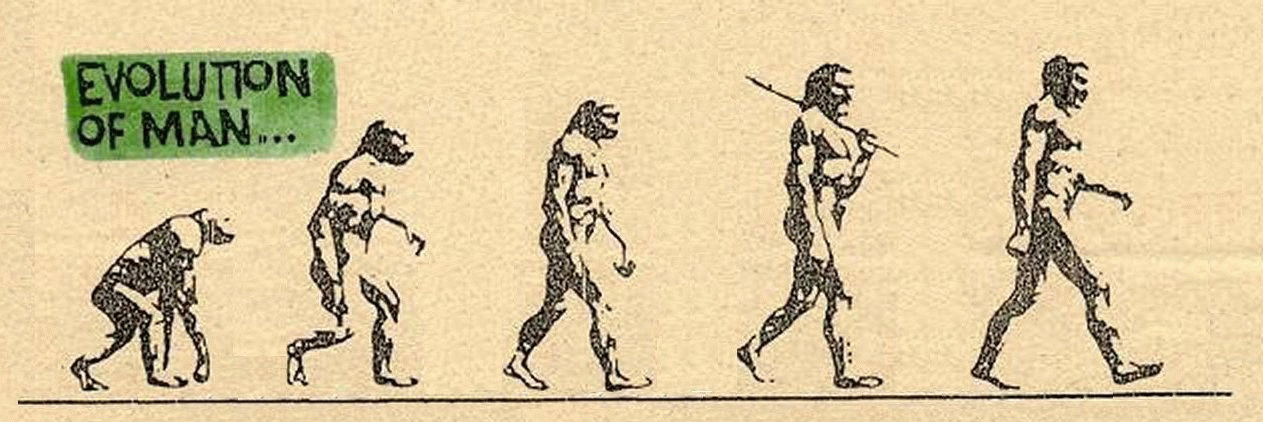
If we compressed the two or three million years of man’s existence into an ordinary twelve-month calendar, from January to December, agriculture would only begin on 28 December. The whole historical era of man, some six to ten thousand years, would fit into the last two days of the year. Let us take note of what happened up to 31 December. In the early hours of the morning, Babylon, China, and Rome rose and fell. Socrates, Plato, and Aristotle lived around 9:30. The history of man moved through the afternoon into the evening. At 20:57, Columbus reached America. At 21:16, Copernicus proved the Earth orbits the sun. At 22:27, Watt perfected the steam engine. At 23:09, Darwin set out the theory of evolution. At 23:21, Fermi split the atom. At 23:41, the first computer was built. Between 23:43 and 23:48, man developed the airplane, the liquid-fuel rocket, the artificial satellite, and the crewed spacecraft. At 23:49, man landed on the Moon. Now it is around 23:50. The curve of science and technology has shot upward. What is next on man’s agenda?
The evolution of man is full of enormous leaps, anomalies so plain that they lead us to ask whether something interfered in the story of our ancestors. Pierre Teilhard de Chardin raised questions about human evolution that went beyond his time. He set them out in two extraordinary books, “The Phenomenon of Man” and “The Appearance of Man.” The basic mystery that puzzled De Chardin was that there seems to be no evolutionary link between Neanderthal man and Cro-Magnon man. Neanderthal was so far below the fully human Cro-Magnon that De Chardin could not see how the first could have evolved, by any logical path, into the second. The gap was too wide and the leap too sudden in the fossil record. In relative terms, Cro-Magnon man seemed to appear on Earth all at once. Given the genetic operations that aliens are supposed to be carrying out on the human population, it is only logical to wonder whether this has something to do with the mystery De Chardin posed. Was Cro-Magnon man placed on Earth intact, or was he the result of a genetic transformation of Neanderthal man, carried out by aliens? At this point it is almost obvious that humanity has been subject to the interference of a third force for some time now.

Legends abound in many parts of the world that tell of contact with celestial beings who helped develop man’s civilization. Such legends were the basis for the complex religious beliefs about gods who came down from the sky. Some serious scholarship has been done here, including “The Sirius Mystery” and “Intelligent Life in the Universe,” co-authored by Carl Sagan and the late, remarkable Soviet scientist I.S. Shklovskii. Sagan and Shklovskii discuss several of these legends, but they are struck in particular by one from the ancient civilization of Sumer. Taken at face value, the legend suggests that contact occurred between human beings and a non-human civilization of immense power, in the lands of the Persian Gulf, perhaps near the ancient city of Eridu, in the fourth millennium B.C. or earlier. Of such legends, Shklovskii writes that, despite the great risk of confusing them with legends born in other ways, such hypotheses are entirely reasonable and worthy of careful analysis. The Russian ethnologist Agrest boldly conjectured that perhaps several facts of the Bible were in truth based on visits by extraterrestrial astronauts to Earth.
It is interesting that Sagan considers Sumer perhaps the first civilization on the planet, almost taking the place of the ancient city of Eridu. Why is this interesting? Because Eridu is called the Babylonian Paradise, the place of man’s origin. The Babylonians were the successors of the Sumerians. There are Babylonian legends that tell a story about Adapa so extraordinarily parallel to the biblical story of Adam that he is called the Babylonian Adam. The inscriptions refer to him as “Adapa, seed of mankind” and “Adapa, the wise man of Eridu.” The Babylonian account of creation, though polytheistic, has so many points in common with the Hebrew account in the book of Genesis that the two must share a common origin. Are these advanced beings agents of God’s creation on this and other planets? Perhaps we should read the Genesis account more literally when it says, “Let us make man in our own image.”
If such alien operations involving genetics did in fact take place in man’s past, they would have been interpreted within the concepts and limits of non-technological cultures. We might expect such events to have been grossly distorted over the centuries. But they would have been so extraordinary that some clear symbol of them should remain, cutting through the noise of ignorance and superstition. It is with that caution that I can say, with the greatest confidence, that the history of man is full of accounts of abductions, sexual encounters, and strange operations involving non-human entities. Such stories are recorded in the religions, myths, and legends of many cultures.
Many have done good work in this field. I would point in particular to Jacques Vallée’s book “Passport to Magonia,” for an intriguing collection of such accounts. They involve human beings abducted by non-human entities, invariably called fairies, gnomes, elves, and demons, among other human labels for the unknown. It is significant that, as in modern UFO abductions, the abducted were forced to forget what happened during the abduction. Vallée states that the mind of a person who has been to the World of the Fairies is, as a rule, wiped clean of what was seen and done there.
Edwin S. Hartland’s book, “The Science of Fairy Tales: An Inquiry into Fairy Mythology,” is another excellent compilation of folklore that, read in the light of ufology, takes on new meaning. Hartland mentions a Swedish book, published in 1775, that contains a legal statement solemnly sworn on 12 April 1671 by the husband of a midwife. He swore that his wife had been carried off to the World of the Fairies by a dwarf-like entity, to assist at a birth. The author of the statement was a priest named Peter Rahn. He claimed that he and his wife were on their farm late one night when a small man came, dark-faced and dressed in grey, who begged the wife to come and help his own wife, then in labor. Seeing that they were dealing with a troll, Rahn prayed for his wife, blessed her, and offered her in the name of God to go with the stranger. She seemed to be carried off by the wind, and the midwife returned home the same way. In our own time, this incident might be reported as an abduction by an alien entity that entered a farm, floated off with the woman, and returned her the same way. The description of the place she was taken to is also striking: she entered an underground passage through a shining metal door, into the home of the little people, which was full of light of no detectable source.
The American researcher John Keel writes that similar stories abound in the Indian records of the Northern Rockies, according to studies by Dr. E. E. Clark, who tells of various tales about tall entities and one-meter-tall entities that carried off Indian children. Keel also reports the findings of the anthropologist Brian Stross, who found intriguing stories of little men while researching the Tzeltal Indians of Chiapas, Mexico. The dwarf-like entities were called ihk’al. The Tzeltal said these small beings carried devices on their backs that let them fly, and that they sometimes carried off women and forced them to give birth.
Vallée points to ancient abduction stories from Chinese and European folklore that match present-day UFO accounts in their relativity of time. I call the common thread the Rip Van Winkle scenario: a person mysteriously disappears for weeks, months, or years, but on returning believes no time has passed at all. Vallée quotes Hartland on Gitto Bach, a farmer’s son who vanished mysteriously. For two years nothing was heard of him, but one morning, when his mother, who had wept bitterly over his death, opened the door, she saw Gitto with a bundle under his arm. He was dressed the same and looked the same as when she last saw him, for he had not grown at all. “Where have you been all this time?” his mother asked. “Why, I was only away for a day,” he replied. Gitto then opened the bundle and showed his mother a suit made of something like white paper, made in such a way that there were no visible seams. He said the suit had been given to him by the little people he had been away with.
Stories of sexual relations between extraterrestrials and humans persist throughout the biblical age. At the start of Genesis we read these provocative words: “And it came to pass, when men began to multiply on the Earth, and daughters were born to them, that the sons of God saw the daughters of men were fair, and they took as wives all whom they chose.” Throughout the Bible, the term sons of God refers to celestial beings called angels, that is, messengers. Taken literally, such stories carry a wider implication. A sexual union between races would mean these extraterrestrial entities were genetically compatible with man. This is borne out as we read on about the offspring of that unlikely union: “In those days there were giants on the Earth, and afterward too, when the sons of God knew the daughters of men and they bore them children.” The Hebrew word for giants, nefilim, literally means the fallen from heaven, because these tall celestial beings fell from the sky. Their hybrid offspring and descendants are mentioned often in the first book of the Old Testament, until the last of them was killed. They were known as the Rephaim, the Emim, the Anakim, the Horim, the Avim, and the Zamzummim. Some scholars speculate that this tradition of giants born of the union of gods and humans formed the basis for the demigods of Greek mythology. The Bible describes these tall hybrid men as mighty men, heroes of old, men of renown.
Beliefs in sexual contact between extraterrestrials and humans were popular in the Middle Ages. In that period we find a strong belief in the existence of the male incubus or female succubus, who forced human beings to have sexual relations with them. Later, these beliefs carried on, disguised, in the folklore of the fairies. Wentz, a scholar of folklore, concludes from his studies that the fairies who seduce mortals in modern times are almost the same as, if not the same as, the succubi of the Middle Ages. Modern times, for Wentz, meant the nineteenth century. A hundred years later we find the twentieth-century counterpart to the angels, demigods, incubi, succubi, and fairies of man’s past. We might well ask at this point what purpose was served, or is being served, by such abductions and sexual encounters. Is there a link between the purpose reported in the past and the one today? As for the motive behind the fairies’ abductions, Vallée again quotes Hartland, who wrote in the nineteenth century that the motive assigned to the fairies in the Northern countries is to preserve and improve their race, on the one hand by taking human children to be raised among the elves and joined to them, and on the other by obtaining milk and nourishment from human mothers for their own offspring. The motive for the abductions by the fairies in the past, and the abductions by UFOs in the present, is one and the same: genetics.
Could it be that alien life forms have, in fact, been living in such a secret relationship with man? Are the so-called Observers dependent on us to perpetuate their own kind? If so, it becomes clear that their survival is closely bound up with the success of their ongoing program of genetic engineering. Whoever created and assigned these celestial caretakers made sure they were faithful to their task. One cannot help asking when this symbiotic kinship with man first came about. How can man be genetically compatible with an alien being?
The creatures that have abducted so many may have been called many things by man, including nefilim, fairies, angels, elves, gnomes, trolls, ihk’al, incubus, succubus, and alien. But the name they answer to goes back to the earliest civilization in Sumer, in Babylon. The Chaldeans, an ancient and dominant people in Babylon, believed in a certain class of angelic beings. These beings were responsible for watching over the conduct of man on Earth. The Chaldean name for this class of celestial entities is “ir,” which, translated, means the Observers.